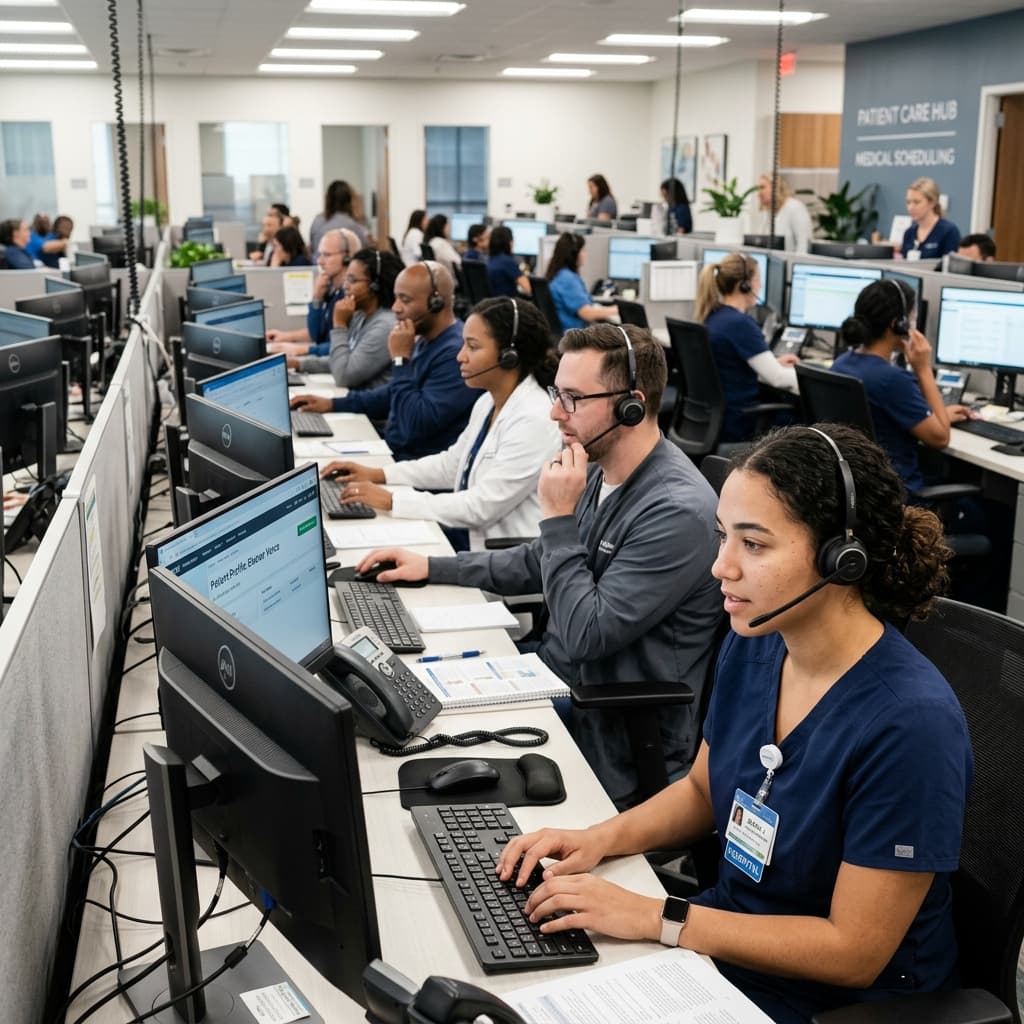
Let me tell you the conversation that made me bet my company on this space. I was at a specialty pharmacy summit, doing what I always do at conferences — skipping the sessions and trying to book as many coffees as possible — and I sat down with the owner of a specialty pharmacy. I asked how they handle patient communication. He said, almost casually, “Right now we do it manually. About 80,000 calls a month.” On roughly 5,000 active prescriptions. I said, “Holy humans, that’s insane.” Because it is. And it’s worth walking through the math, because the math is the whole investment case.
Run the numbers
80,000 calls a month. Call it roughly 3,600 calls every business day. If a human handles, generously, 50-60 meaningful patient calls in a day — with documentation, lookups, and the emotional weight of these conversations — you need on the order of 60-70 full-time people just moving the phone traffic. That’s a small army, and it’s an army doing work that is mostly repetitive: status checks, refill confirmations, reminders, delivery coordination, verification follow-ups.
Now layer in the friction we’ve covered in this series. Across healthcare, hold times average over four minutes against a 50-second benchmark, and about 30% of patients hang up after a minute. Only half of issues get resolved on the first contact. So a meaningful fraction of those 80,000 calls are repeat calls — patients calling back because they couldn’t get through or didn’t get a resolution. The pharmacy isn’t just making 80,000 productive calls; it’s absorbing a lot of waste motion on top of the real work.
Where the money leaks
Every link in this chain we’ve examined separately, but here they compound. Calls abandoned on hold are anxious patients drifting toward a lapsed refill. Blocked refills nobody had time to clear are high-value prescriptions sitting in limbo. Benefit verification stuck in phone tag is patients missing the 48-hour window and never starting. Adherence calls that don’t get made are patients in the 60% who quit within 30 days. A single specialty pharmacy is leaking revenue at every one of these points simultaneously, and the root cause is the same: 80,000 calls’ worth of communication and not enough humans to do it well.
What automation does to the math
Here’s the reframe. A voice agent doesn’t handle 50 calls a day; it handles them all, in parallel, with no hold time and no fatigue. The healthcare deployments that are public about results show hold times dropping 60-80% and abandonment falling 50-70% within months for operations handling thousands of monthly calls, with mature deployments targeting under 5% abandonment. Translate that to our pharmacy: the routine majority of those 80,000 calls get handled instantly and automatically, the repeat-call waste largely evaporates because patients get through the first time, and the human team — instead of 60+ people drowning in dial tone — gets redeployed onto the clinical and emotional work that actually needs them.
The economics aren’t subtle. You’re taking a workflow that requires dozens of FTEs and a workflow that’s leaking revenue at every step, and you’re collapsing the cost while plugging the leaks at the same time. That’s the rare automation that improves the top line and the bottom line together.
Why one pharmacy is the proof of the whole thesis
This single pharmacy — 5,000 prescriptions, 80,000 manual calls — is a microcosm of the entire industry. The market is fragmented, mostly independent pharmacies, each one running some version of this same overwhelmed phone operation. Win one, prove the math, and you have a case study that travels, because the next pharmacy has the exact same problem. That’s the part that got me. It wasn’t just one painful operation. It was thousands of them, all doing 80,000 calls by hand, all waiting for someone to finally do the math.