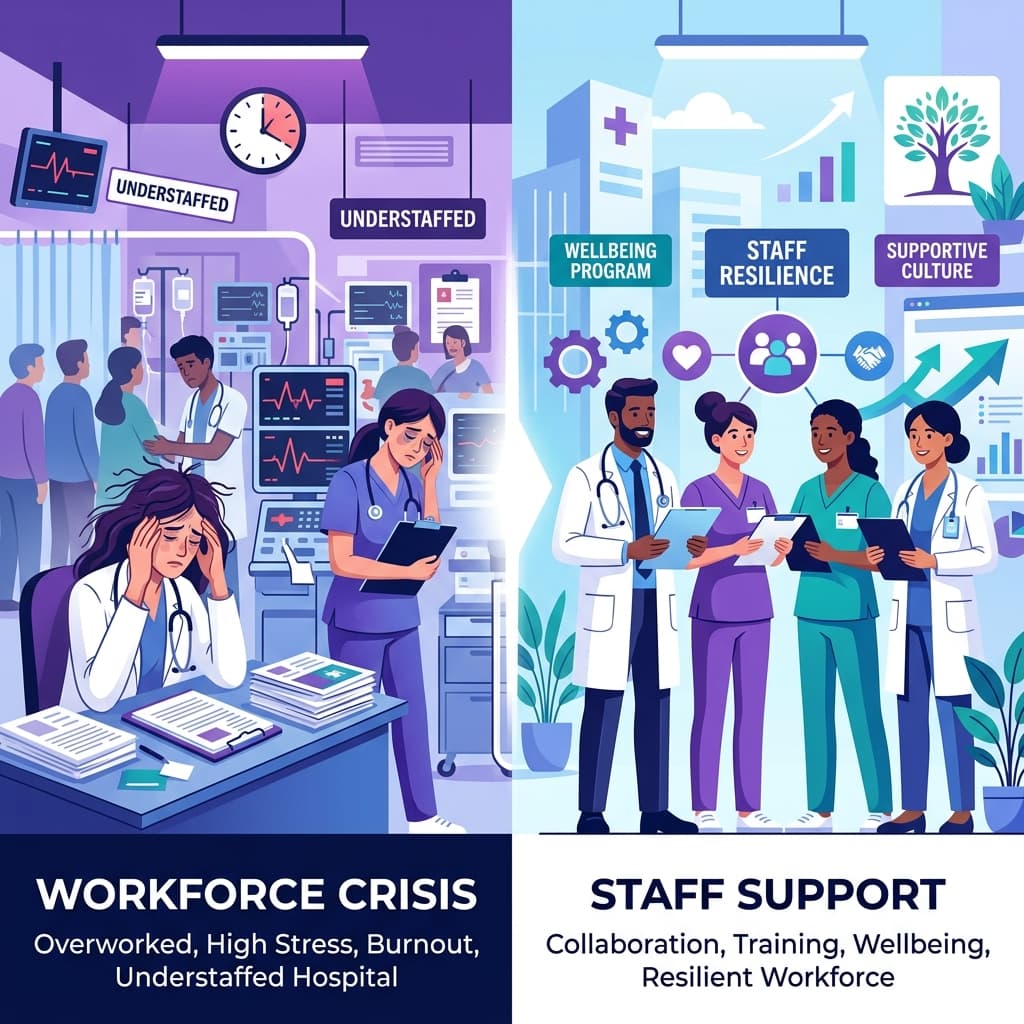
Every specialty pharmacy growth plan I've ever seen has the same silent assumption buried in row 40 of the spreadsheet: that when volume grows, you'll be able to hire the people to work it. Techs for intake, CSRs for the phones, billers for the denials, clinicians for the assessments. It's the assumption nobody stress-tests, because for most of the industry's history it held.
It doesn't hold anymore, and I'd argue the labor market — not reimbursement, not payer consolidation — is the binding constraint on specialty pharmacy growth for the rest of this decade.
The numbers, without varnish
The pharmacy workforce data has been grim for years and is not improving. ASHP's surveying has put pharmacy technician turnover above 20% — with plenty of sites reporting worse — and vacancy rates reaching as high as 40% in some settings. Burnout measurements are bleaker still: the Well-Being Index found burnout highest among pharmacy professionals *of all practice types*, with roughly two-thirds reporting it, and some research putting the share of pharmacists at high risk near nine in ten. Job postings keep climbing while training pipelines stay flat. "Lack of pay and incentives" leads every exit-survey ranking, followed closely by workload and inadequate staffing — a doom loop, since every departure increases the workload on whoever stays.
Now overlay specialty's specific labor problem: the roles that gate throughput aren't generic. A benefit verification specialist who knows the difference between a J-code PA and a pharmacy-benefit PA, an intake coordinator who can read a dirty referral, a biller who understands accumulator sequencing — these take six to twelve months to become productive. Which means a resignation doesn't cost you a headcount; it costs you a headcount, six months of a trainer's attention, and every piece of tribal knowledge that person carried. At 20–25% annual turnover, a 40-person ops floor is perpetually running a training academy with a graduating class that keeps leaving.
And here's the growth-killer: patient volume in specialty compounds — more approvals, more indications, more limited-distribution drugs, an aging population on biologics — while the labor pool that services it shrinks. Two curves, diverging. Every operator feels this as the same recurring meeting: the one where you decide which service level to quietly degrade this quarter because the req has been open for four months.
What the work actually is
Break down what those scarce humans spend their days on, and the constraint gets stranger. Time-and-motion studies of pharmacy operations floors keep finding the same split: the majority of a technician's or CSR's day goes to repetitive telephony and data movement — hold queues with payers, status dials to prescriber offices, refill-reminder outbounds, "where's my order" inbounds, copying data between the PMS and a portal. The judgment-heavy work that actually requires a trained human — resolving an ambiguous rejection, de-escalating a frightened patient, catching a clinical red flag — is a minority slice of the day, squeezed between calls.
So the industry's scarcest resource — trained pharmacy labor — is being spent overwhelmingly on its least demanding tasks. We have a shortage of skilled people largely because we waste the ones we have on unskilled minutes. That's not a hiring problem. That's a work-design problem.
The automation reframe: capacity, then retention
The obvious case for AI here is capacity arithmetic: voice agents that handle the refill outbounds, the status inbounds, the payer hold queues, and the prescriber chases don't call in sick, don't need six months of training, and scale with volume instead of with the local labor market. When your January surge hits, concurrency goes up; nobody works a double. Fine — every vendor says that. Let me make the two arguments I think matter more.
First, **automation is a retention strategy**, and almost nobody frames it that way. Go re-read the exit-survey drivers: workload, understaffing, and the grinding repetitiveness of the phone queue. The techs who leave aren't fleeing pharmacy — they're fleeing eighty daily renditions of hold music and the 61st identical refill call. Strip the rote telephony out of the role and what remains is the job people thought they were signing up for: patient problem-solving, clinical support, exception handling. That job retains people. Several operators I've spoken with discovered this backwards — they deployed voice AI for throughput and only noticed two quarters later that ops attrition had dropped, because the humans finally had humane jobs. The ROI model everyone builds counts saved headcount; the one nobody builds counts *avoided turnover*, at one-half to twice an annual salary per departure prevented.
Second, **automation is how tribal knowledge stops walking out the door**. Today, "how we handle this payer's weird rejection" lives in the head of your best biller, who is one recruiter call from leaving. When workflows run through AI agents, the payer-specific logic, the escalation criteria, the phrasing that works with a given plan's IVR — all of it is captured in the system, versioned, auditable, and permanent. New hires stop inheriting chaos and start inheriting infrastructure. The institution finally learns faster than it forgets, which — at 25% turnover — is the whole game.
"AI is taking pharmacy jobs" deserves a straight answer
I won't pretend the composition of pharmacy employment stays static; roles built entirely of rote calls will shrink. But look at the actual state of the labor market before mourning: vacancy rates up to 40%, open reqs aging past a hundred days, mandatory overtime, and services *not offered* because there's no one to staff them. Specialty pharmacy's problem isn't too few jobs — it's too few people willing to do jobs the industry made miserable. The realistic near-term outcome of automation isn't layoffs; it's finally closing the gap between the service level pharmacies promise and the one their staffing can deliver, while making the remaining roles senior, clinical, and worth staying in.
There's also a patient-safety point hiding here that deserves more airtime: overloaded, burned-out staff make errors. Every study of pharmacy burnout links it to mistakes and near-misses. Offloading volume from exhausted humans isn't just an economic decision — it's a quality decision.
The change management nobody budgets for
A candid word on implementation, because the technology is the easy half. The hard half is that your ops floor will hear "voice AI" as "layoffs," and if leadership doesn't address that head-on in week one, the project will be quietly sabotaged by the exact people whose cooperation it needs — the senior techs whose tribal knowledge has to be encoded into the system.
What works, from watching deployments succeed and fail: name the redeployment plan *before* the pilot, not after. "The AI takes the refill outbounds; the three people currently doing them move to the PA escalation queue we've never been able to staff" is a sentence that recruits allies. Put your best skeptic on the implementation team — the twenty-year tech who thinks this is nonsense is also the person who knows every payer quirk the agent must handle, and converting her converts the floor. Publish the escalation stats internally from day one, because the fastest way to build trust is showing staff that the AI hands off when it should. And revisit job descriptions and pay bands within the first two quarters: if the rote work leaves the role, the role is now more senior, and compensation that doesn't follow will manufacture the turnover you were trying to prevent.
Skip this work and you'll get the failure mode every vendor has seen: technically successful automation, organizationally rejected, quietly worked around until the renewal quietly dies. Do it and something better than adoption happens — the floor starts proposing the next workflow to automate, because they've felt what it's like to stop being a phone bank.
The operator's takeaway
If you run a specialty pharmacy, run this exercise honestly: take your open reqs, your current time-to-fill for those roles, your trailing-twelve-month attrition, and your projected referral growth, and model your service levels eighteen months out assuming *hiring performance stays exactly as it is*. For most operators the output is unambiguous: on the current trajectory, the phones get slower, the intake queue gets longer, and the clinical program gets thinner — not because anyone chose that, but because arithmetic doesn't negotiate.
Then model the alternative: automation absorbing the rote telephony, humans redeployed to the exception and clinical work, hiring redirected from backfilling churn to building capabilities. Same labor market. Completely different pharmacy.
The industry spent twenty years assuming labor would always be there and treating automation as optional. The labor market has now inverted the sentence. The people are optional to the payroll only because they were never available to hire; the automation is what's no longer optional.