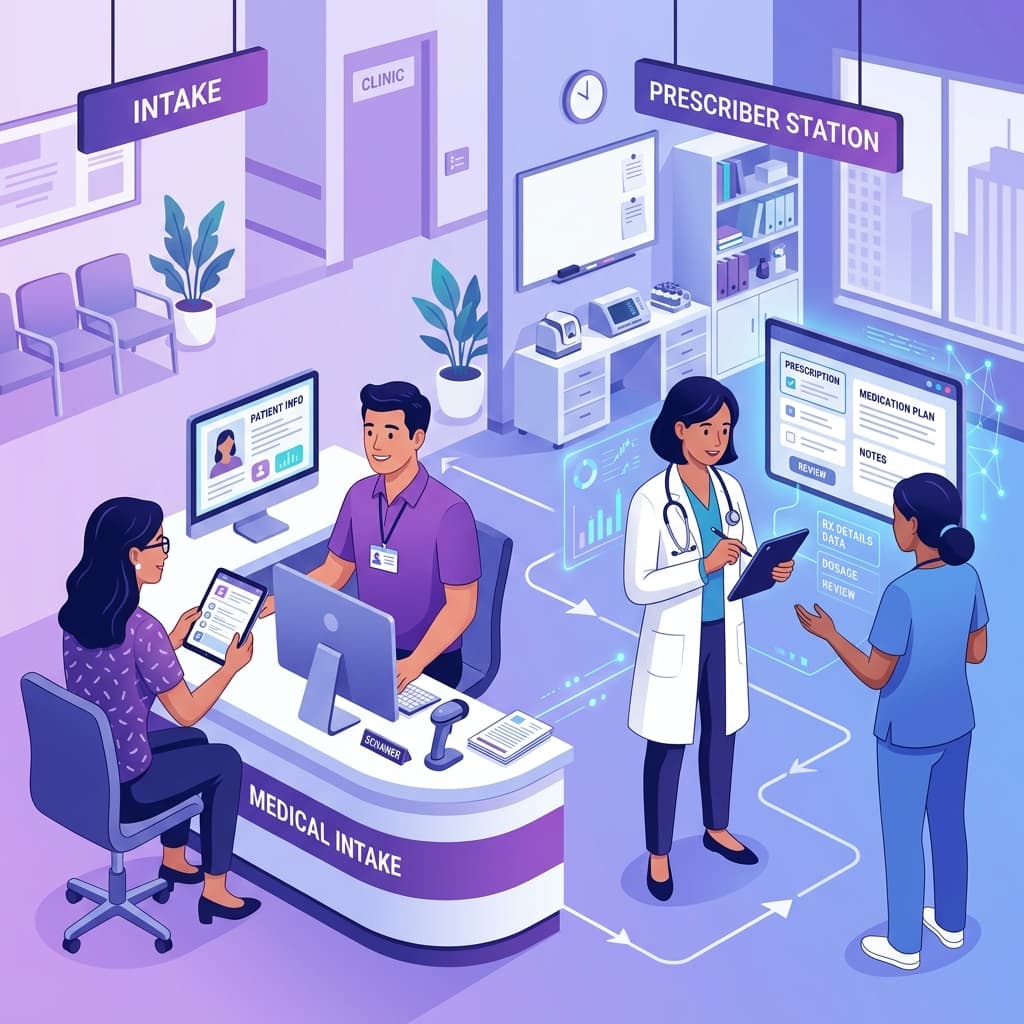
Ask a specialty pharmacy operator where their time-to-therapy goes, and they'll usually point downstream — the payer, the PA queue, the copay problem. Fair enough. But I've become convinced the most underrated delay in the entire journey happens in the first 48 hours, before the payer even knows the patient exists. It happens at intake, and it happens because of what the industry politely calls "incomplete referrals" and what intake teams call something I can't print.
What a dirty referral actually is
A specialty referral is supposed to arrive with everything the pharmacy needs to work the case: demographics, insurance card front and back, diagnosis with ICD-10 code, the prescription itself, chart notes, labs, prior therapies tried and failed, and — for a growing list of drugs — REMS documentation, weight-based dosing inputs, or genetic test results. That's the theory.
The practice: a fax (yes, still a fax, even in 2026, even with e-prescribing everywhere) arrives with a script and a face sheet. No chart notes. An insurance ID from the plan the patient had last year. A diagnosis code that doesn't match the drug's label or the payer's policy. A missing NPI. An enrollment form where the prescriber signed but didn't date, which some hubs and payers will bounce on principle.
Surescripts' research on this is blunt: inaccurate and incomplete data is the top stressor specialty prescribers and pharmacists report, and improperly completed forms are cited by nearly two-thirds of prescribers and three-quarters of specialty pharmacists as the leading cause of delay. The industry's average time from referral to paid fill for specialty medications hovers around 29 days. More than 80% of prescribers and pharmacists agree it should take two weeks or less. Only 20–30% say it actually does. The gap between those numbers is largely made of missing information and the phone calls required to get it.
The chase
Here's the workflow nobody puts on the website. An intake coordinator reviews the fax, builds the patient in the pharmacy management system, and discovers three gaps. Now the chase begins: call the prescriber's office. Reach the front desk. Get transferred to the MA who handles specialty. She's with a patient. Leave a message. Call back after lunch. The office's fax-back arrives — it's the same chart note they already sent, not the labs you asked for. Call again. The office closes at 4:30 local time. Try tomorrow.
Each round trip costs a day. Three gaps at two round trips each and you've burned a week before benefit verification even starts — and BV or PA will frequently surface *new* documentation gaps, restarting the chase with higher stakes. Meanwhile the patient, who was told at the doctor's office that "the pharmacy will call you," has heard nothing, and their first impression of your high-touch patient management program is silence.
There's a commercial angle, too, that operators feel acutely: referral leakage. When a referral stalls in intake, prescriber offices do the rational thing — they resend it to a competitor, or the payer's network rules sweep it to a PBM-owned specialty pharmacy while you're waiting on chart notes. Every day a referral sits un-worked is a day it can be poached. Intake speed isn't just a patient-experience metric; it's market share defense.
Why this is a near-perfect AI problem
Intake has three properties that make it unusually automatable, and I say this as someone who's skeptical of "AI fixes everything" pitches.
First, the extraction problem is solved. Reading a messy inbound package — fax, e-referral, portal PDF, scanned enrollment form — and structuring it into discrete fields is exactly what modern document AI does well. More importantly, the *gap analysis* is deterministic: for a given drug, payer, and program, the required-elements checklist is knowable. Software can grade a referral as complete or incomplete, itemize what's missing, and do it in the first five minutes instead of the first five hours. Pharmacies doing this today report intake processing dropping from hours to minutes per referral.
Second — and this is where voice AI changes the game — the chase itself is a phone workflow. An autonomous voice agent can call the prescriber's office the moment the gap analysis completes, navigate the phone tree, ask specifically for "the office visit note from the last 90 days and the most recent CBC for patient X, fax or portal, here's the callback number," and then *actually follow up tomorrow* if nothing arrives. Not "task created for follow-up when a coordinator gets to it" — actually calls, at 9:05 a.m. when the office phones open, every day until the document lands. Persistence without headcount. And because the agent works from the same checklist as the gap analysis, it asks for everything in one call instead of discovering gaps serially across three.
Third, the patient side of intake — welcome call, demographic confirmation, consent to the patient management program, preferred contact windows, allergy history — is highly scriptable and desperately time-sensitive. Getting a welcome call out within an hour of referral receipt, instead of within three days, does two things at once: it captures the patient before a competing pharmacy does, and it collects data that unblocks everything downstream. Voice AI makes the one-hour welcome call the default rather than the aspiration, in the patient's language, at the time they actually pick up.
Put those together and the intake pipeline inverts. Instead of a coordinator queue where every referral waits its turn for a human to discover what's wrong with it, every referral is triaged, gap-checked, and *already being chased* by the time a human looks at it. The coordinator's job shifts from data entry and phone tag to exception handling: the ambiguous diagnosis, the prescriber who insists the payer is wrong, the package that needs a pharmacist's eye.
The objections, honestly handled
"Prescriber offices will hate getting calls from an AI." Some will — and offices already hate getting four calls from four different humans at the same pharmacy asking for overlapping things. A well-built agent calls once, asks for a complete and specific list, offers multiple return channels, and never asks for a document that's already on file. In my experience the MA who handles specialty referrals doesn't care who's calling; she cares whether the call is short, specific, and doesn't repeat itself. That's a bar AI clears more reliably than a burned-out coordinator on their 60th call of the day.
"Our referrals are too messy for automation." That's precisely backwards. Clean referrals don't need automation — they sail through. The messier your inbound mix, the more your throughput is gated by gap-detection and chase capacity, and those are the two things automation multiplies.
"Intake is where we build the prescriber relationship." Agreed — and nothing damages that relationship like slow starts and repeated document requests. The pharmacies winning referral share are the ones whose offices say "send it to them, it just gets done." Speed *is* the relationship.
What about e-referrals? Won't better standards fix this upstream?
The optimist's counterargument deserves airing: electronic referral standards, EHR-integrated specialty enrollment, and e-prescribing enhancements are all supposed to make dirty referrals extinct at the source. NCPDP specialty data standards keep maturing, the big EHR vendors keep adding specialty medication enrollment workflows, and every industry panel for a decade has promised that structured data exchange will end the fax era any year now.
I'm genuinely for all of it — and I'd caution any operator against building their throughput plan on it. Three reasons. First, adoption is a decade-long curve with a brutally long tail: your referral mix will include community practices on aging EHR configurations, fax-first offices, and out-of-network prescribers for as long as you're in business. Second, structured doesn't mean complete — an e-referral with a missing lab value is just a cleaner-looking gap, and the chase is identical. Third, and least appreciated: even perfect referral data doesn't eliminate the *conversational* work of intake — the patient welcome, the consent capture, the coordination when the payer wants something the chart doesn't contain. The pipe can be pristine and the phone work remains.
So the practical posture is both/and: pursue every e-referral integration your prescriber base will adopt, and run an AI chase layer that makes you indifferent to how messy the remainder arrives. The pharmacies that win referral share won't be the ones that waited for the industry's plumbing to improve. They'll be the ones whose intake performed like the plumbing already had.
The metric that matters
If you run intake, track one number above the rest: time from referral receipt to complete, workable case. Not time to first touch — time to *complete*. Everything downstream (BV, PA, fill, ship) is bounded by it, and it's the number AI moves most dramatically, because it attacks both halves: instant gap detection and tireless gap closure.
Twenty-nine days from referral to paid fill is not a law of physics. It's an artifact of fax machines, phone tag, and queues. Two of those three are now optional.