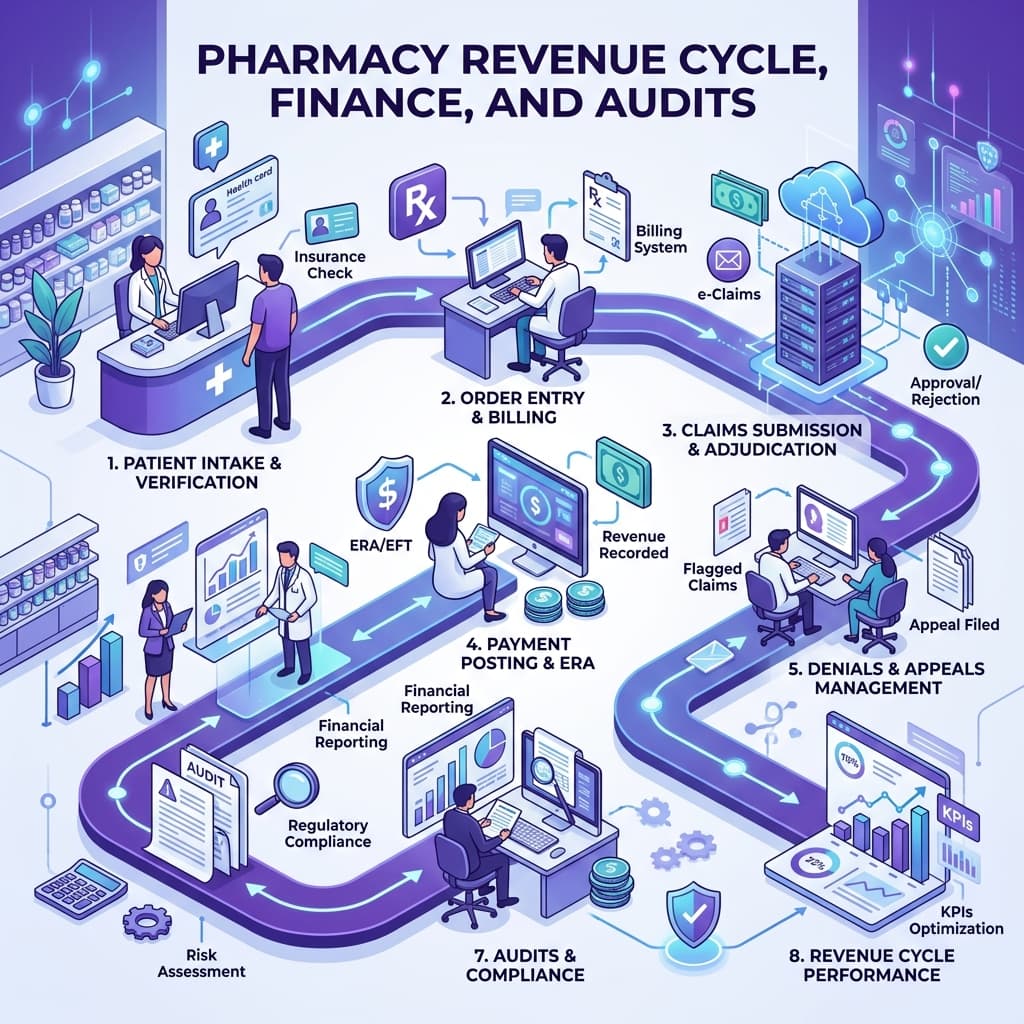
Everyone in this industry can tell you their gross margin. Very few can tell you, on the day a claim adjudicates, what they'll actually keep. That's not a knock on operators — it's the defining pathology of specialty pharmacy revenue cycle: you dispense a $14,000 drug today and discover what you were really paid for it months later, after the clawbacks, the audits, the underpayments, and the write-offs have all taken their bite.
I want to walk through where the money leaks, because the pattern that emerges is striking: almost every leak is a documentation and follow-up problem, and documentation and follow-up are exactly what AI automates best.
The DIR hangover and the new margin math
For years, the signature grievance was retroactive DIR fees — performance-based clawbacks that Part D plans and their PBMs assessed months after dispensing, frequently calculated as a percentage of the drug's cost, which at specialty price points meant thousands of dollars vanishing from a single claim long after the books were closed. CMS finally ended retroactive DIR beginning in 2024, moving all pharmacy price concessions to the point of sale.
Anyone who expected relief got a lesson in conservation of margin: PBMs responded with sharply lower upfront reimbursement, and pharmacies traded unpredictable clawbacks for predictable underwater claims. Meanwhile the transition year forced pharmacies to absorb trailing 2023 clawbacks *and* reduced 2024 point-of-sale rates simultaneously — the "DIR hangover" that pushed more than a few independents out of specialty entirely. The strategic lesson stands: reimbursement pressure doesn't disappear, it migrates. Today it lives in effective-rate contracts that true-up against GER/BER guarantees, in below-cost reimbursement on select NDCs, and in an audit apparatus that has become, functionally, a revenue stream for the payer side.
The audit machine
PBM audits were sold as fraud prevention. In practice, desk audits and on-site audits sweep thousands of claims looking for *documentation defects*, not fraud: a missing date on a hardcopy, a day-supply calculation that doesn't match the sig, an unrecorded patient contact for a delivery, a copay collected but not documented, a refill shipped one day earlier than the plan's refill-too-soon window allows. Any defect can trigger full recoupment of the claim — not the margin, the *entire reimbursement* — on a drug the pharmacy already bought and shipped. At specialty prices, a handful of paperwork findings can erase a month of profit.
And the burden of proof sits entirely with the pharmacy. Win rates on audit appeals are decent *when the documentation exists*. The tragedy is how often the pharmacy did the right thing and simply can't prove it, because the proof lived in a phone call nobody documented completely, or a signature log nobody scanned.
Medical benefit billing: the other half of the iceberg
Specialty is also unique in straddling two reimbursement universes. Pharmacy-benefit claims adjudicate in real time through NCPDP transactions — reject codes are annoying but immediate. Medical-benefit billing (infusions, provider-administered drugs, white-bagging arrangements, anything billed on an 837P with J-codes) is a different animal: prior auth attached to the wrong benefit, units-billed errors on J-code conversions, NDC-to-HCPCS crosswalk mistakes, timely filing windows, and denials that surface 45 days later and take months to appeal. Authorization and documentation gaps are the dominant driver of medical-benefit denials, and every denial is a receivable aging toward a write-off while a biller works a queue that never gets shorter.
Add the routine slow bleeds — secondary/tertiary coordination-of-benefits nobody re-ran after a plan change, underpayments below contracted rates that no one reconciles line-by-line because the remittance files are enormous, copay assistance billed to the wrong payer sequence — and you get the quiet truth of specialty revenue cycle: the leaks are individually small and collectively enormous, and plugging them requires exactly the kind of meticulous, high-volume, low-glamour follow-up that understaffed billing teams cannot sustain.
What AI changes: from sampling to totality
Here's the frame I'd offer: today, every safeguard in pharmacy revenue cycle runs on *sampling*. Billers work the biggest denials. Audit prep reviews a subset of claims. Reconciliation spot-checks remittances. Sampling exists because human attention is scarce. AI's core economic contribution to revenue cycle is making attention abundant — moving every one of these processes from sampling to totality.
Concretely. **Audit-proofing at the point of work:** if voice AI agents are already making your patient calls — refill consent, delivery scheduling, counseling offers, copay collection — then every one of those interactions is automatically recorded, transcribed, timestamped, and filed against the claim. The documentation defect that costs you a full recoupment simply stops occurring, because documentation is no longer a human afterthought; it's a byproduct of the call itself. When the audit letter arrives, the evidence package assembles itself. I'd go further: within a few years, "we can produce a transcript of every patient contact" will be table stakes in audit defense, and pharmacies still relying on free-text notes typed from memory will be paying for it, claim by claim.
**Pre-adjudication claim scrubbing that actually learns:** rules-based scrubbers catch what they were configured to catch. An AI layer trained on your own historical rejects and recoupments catches the payer-specific patterns — this plan bounces this NDC unless the DAW code is set, this MAC list underpays this GPI, this BIN requires this PA type on the medical side. Every claim gets checked against everything you've ever been burned by.
**Denial and underpayment work at 100% coverage:** AI agents can parse every 835 remittance line against contracted rates, flag every underpayment (not just the big ones), draft the appeal with the supporting documentation attached, and — where the payer's process requires it — put a voice agent on the phone with provider services to check status, sit on hold, and log the reference number. Appeals stop dying of timely-filing deadlines because follow-up is no longer rationed.
**Cash-flow visibility:** when clawback exposure, aging denials, and true-up liabilities are extracted and modeled continuously instead of discovered quarterly, the CFO conversation changes from forensics to forecasting. In a business where you front the inventory cost of five-figure drugs, knowing your real net on dispense day is not a nicety — it's survival math.
Sequencing the build
If I were a specialty pharmacy CFO deciding where to point this first, I'd resist the temptation to start with the biggest number (usually denials) and start instead with the fastest feedback loop: **documentation capture on patient calls**. It requires no payer cooperation, no integration marathon, and it compounds — every recorded, transcribed, claim-linked interaction from today forward is audit armor you didn't have yesterday. You'll feel the value the first time a desk audit letter arrives and the response package takes an afternoon instead of three weeks.
Second, **835 reconciliation at full coverage**, because it's pure found money with no workflow change: the remittance files already exist, the contracted rates already exist, and the delta between them has simply never been computed line-by-line. Every operator who runs this analysis for the first time finds underpayments they didn't know about; the only question is the size.
Third, **denial follow-up automation**, where the voice component earns its keep — status checks with provider services, resubmission confirmations, reference-number capture. This is where timely-filing write-offs go to die, in a good way.
Fourth, and only once the data layer is trustworthy: **the payer-level analytics** — effective rate by contract, margin by NDC, audit-finding patterns by plan — that turn your revenue cycle from a cost center into the intelligence function backing every contracting decision. A special note for covered entities: if you're running 340B contract pharmacy arrangements, the same claim-level visibility does double duty in duplicate-discount compliance and manufacturer audit response, which is its own escalating headache and deserves its own article.
The pattern across all four stages is identical: the money was always yours; the labor to claim it never existed. Now it does, and it costs a fraction of what it recovers.
The honest caveat
None of this fixes the underlying economics. If a contract reimburses below acquisition on a given NDC, no amount of automation makes that claim profitable — that's a contracting and payer-strategy problem, and it belongs to humans with negotiating leverage (though even there, AI-assembled data on effective rates by payer and NDC is precisely the ammunition those humans need to walk into the negotiation armed).
What automation does fix is the gap between what you negotiated and what you actually collect — the leakage layer. Ask any specialty CFO to estimate that layer and you'll hear numbers between two and five percent of revenue. In a business running on single-digit net margins, recovering even half of that isn't an efficiency initiative. It's the difference between a pharmacy that survives the next reimbursement cut and one that doesn't.
The PBMs industrialized their side of the ledger years ago. It's time the pharmacy side did the same.