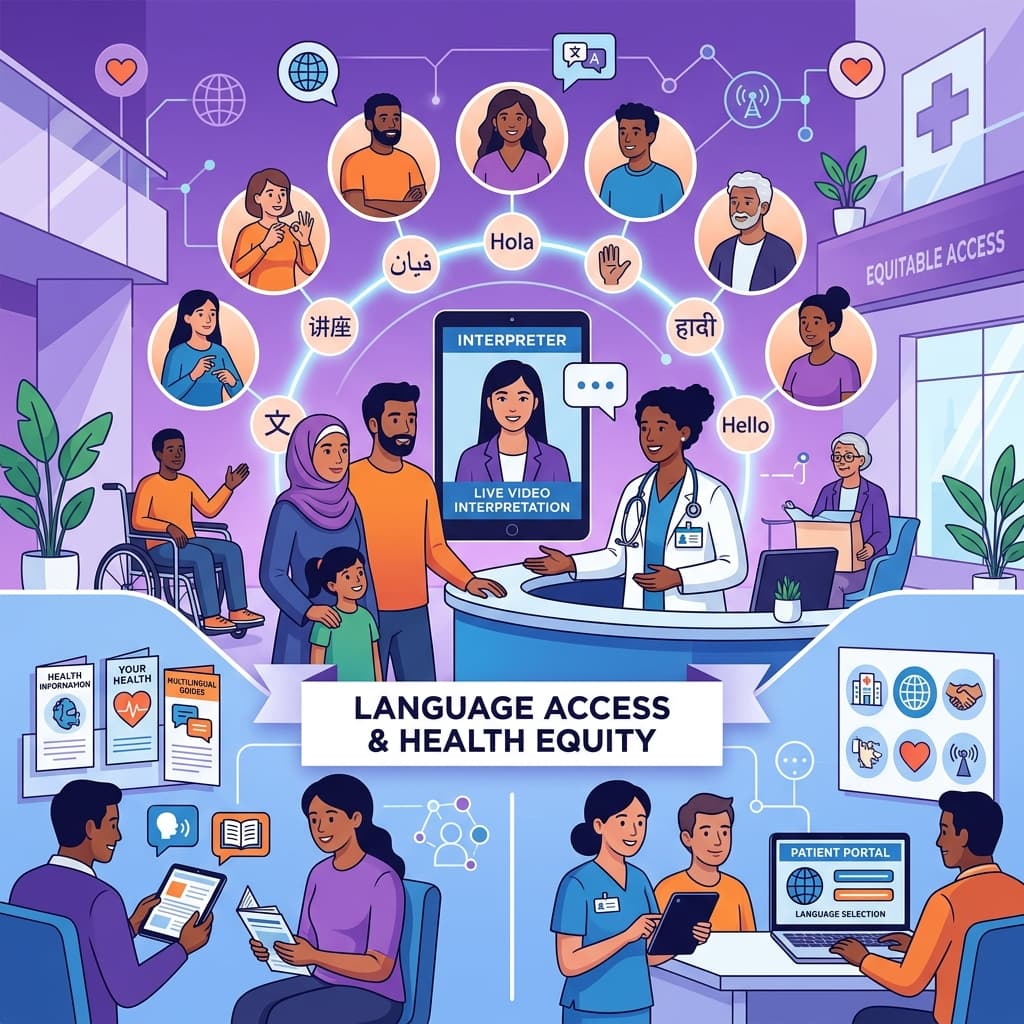
Here's a patient journey the industry doesn't like to look at directly. A Spanish-speaking patient gets a referral for a self-injected biologic. The welcome call comes in English; she lets it go to voicemail, which she can't fully follow. The refill reminder is an English text. The injection-training offer never lands. When a side effect scares her, she doesn't call the pharmacy — the last call required her teenage son to interpret, and she's not putting him through a conversation about her body again. Three months later she shows up in the discontinuation data, and the pharmacy's dashboard files her under "patient chose to stop therapy."
She didn't choose anything. The channel failed her.
The scale of the gap
Roughly 25 million people in the United States have limited English proficiency (LEP), and the clinical literature on what that means for medication use is consistent and damning: lower comprehension of medication instructions, worse adherence, worse outcomes — with the effects sharpest exactly where specialty pharmacy lives, in complex regimens requiring titration, injection technique, side-effect management, and sustained engagement. When professional interpretation isn't used consistently, LEP patients do measurably worse; when patients are language-concordant with their care, adherence improves. None of this is controversial. It's just expensive to act on.
This isn't only an ethics story, either. It's a compliance obligation — Section 1557 of the ACA requires federally funded providers (which is to say: any pharmacy taking Medicare or Medicaid) to provide qualified language assistance free of charge, with updated requirements in force as of 2024, and "your nephew can interpret" explicitly outside the lines. And it's a commercial story: LEP populations are large, growing, concentrated in exactly the disease states specialty serves, and — because competitors serve them equally badly — they're the most undercontested patient population in the industry.
Why the current model can't close it
Most specialty pharmacies handle language access the way the rules technically require and the workflow quietly defeats: a telephonic interpreter line. On paper, compliant. In practice, look at what it does to the interaction. The CSR recognizes the language gap, puts the patient on hold, dials the interpreter vendor, waits for an available interpreter in that language, then conducts every exchange in relayed halves at double the handle time and per-minute vendor pricing. The call works, barely, when the *patient* initiates and is willing to endure it.
But specialty pharmacy's whole model is *outbound* — welcome calls, adherence check-ins, refill reminders, assessment interviews, cold-chain delivery scheduling. Nobody conferences an interpreter onto an outbound dial on the chance a Vietnamese-speaking patient answers. So outbound programs default to English, LEP patients silently fall out of every proactive workflow, and the pharmacy's high-touch program becomes, for a tenth of its panel, a no-touch program. The result shows up as "unreachable" and "non-adherent" flags that are really just mislabeled language mismatches. Ad hoc interpretation by bilingual staff — the other common patch — is noble, unscalable, and vanishes with every schedule change; family-member interpretation is a privacy problem, an accuracy problem, and for sensitive clinical content, a dignity problem.
What changes when the agent speaks the language natively
Modern voice AI is natively multilingual — not translated scripts bolted on, but agents that conduct a full conversation in Spanish, Mandarin, Vietnamese, Korean, Tagalog, Arabic, Haitian Creole, and dozens more, and can detect language preference at "hello" and switch mid-call. Consider what that actually does to the workflows above.
Every outbound program becomes language-complete by default. The refill reminder, the welcome call, the PRO assessment, the delivery confirmation — each goes out in the patient's documented (or detected) preferred language, at native fluency, with no interpreter conference, no double handle time, no per-minute vendor meter. The marginal cost of serving an LEP patient drops to the marginal cost of serving anyone, which is the precondition for equity at scale: parity that doesn't depend on budget heroics.
The interaction quality changes character, too. A relayed interpreter call is a negotiation with awkwardness — pauses, summarized halves, patients trimming their questions to spare everyone the friction. A direct conversation in the patient's language restores the thing specialty pharmacy claims as its differentiator: the patient actually telling you what's going on. Ask anyone who's run bilingual outreach — patients disclose more, ask more, and stay engaged longer when the conversation simply happens in their language. Side-effect reports surface earlier. Injection-technique confusion gets caught before it becomes a wasted $8,000 fill. The teenage son goes back to being a teenager instead of a medical interpreter.
And the documentation improves rather than degrades: the call is transcribed, the English summary lands in the PMS for staff, the language preference is captured as structured data feeding every future touch, and the pharmacy can produce — for a URAC reviewer or a 1557 inquiry — an auditable record of language-appropriate service on every interaction. Try assembling that from interpreter-line invoices.
The boundary rule stays what it always is: escalations route to humans — a pharmacist plus a qualified interpreter, or bilingual clinical staff — and a well-designed agent hands off with the transcript and a summary in both languages, so the interpreter conversation starts warm instead of cold. AI for reach, humans for depth. In every language.
Getting it right: the pitfalls that matter
Because this is healthcare and not a food-delivery app, multilingual AI deserves real scrutiny, and there are three failure modes worth engineering against explicitly.
The first is translation instead of localization. A Spanish script that is grammatically perfect and culturally tone-deaf — wrong register, wrong formality, idioms that land strangely — signals "afterthought" as clearly as English would. Serious deployments review scripts with native-speaking clinicians per language, not per Google Translate, and pay attention to dialect: the Spanish that sounds natural to a Cuban-American retiree in Miami and a Mexican-American teenager in Phoenix is not identical, and voice AI can now respect that where a one-size script never could.
The second is uneven quality across languages. Speech recognition and synthesis are superb in the top ten languages and merely good in the long tail; a pharmacy shouldn't discover its Haitian Creole recognition accuracy from patient complaints. The fix is unglamorous: per-language QA before launch, transcript audits by bilingual reviewers after, and honest fallback rules — if the AI's confidence in a language drops below threshold, route to a human interpreter rather than soldier on. Compliance with Section 1557's "qualified" standard demands nothing less.
The third is treating language preference as static data. Patients code-switch; a patient may prefer English for logistics and Spanish for anything clinical; households share phones across generations and languages. Good agents re-confirm language at the top of sensitive calls and update the preference record every time — turning what used to be a stale intake checkbox into a living field.
None of these pitfalls argues against the channel. They argue for building it like the clinical infrastructure it is, with the same validation discipline you'd apply to any other patient-facing system.
The equity argument is also a growth argument
I want to close on the uncomfortable incentive question, because mission alone rarely reprioritizes a roadmap. Here's the cold-blooded case: your LEP panel is the segment where the *most* adherence value is currently being destroyed by the *cheapest* problem to fix. These are patients already prescribed, already approved, already on your roster — no acquisition cost — discontinuing at elevated rates for reasons that have nothing to do with clinical response and everything to do with a channel mismatch. Every percentage point of adherence recovered in that panel is pure retained revenue and pure improved outcomes data, the same data your value-based contracts and accreditation benchmarks feed on. Health-system and payer partners increasingly ask about health-equity capabilities in RFPs; "our entire outbound program runs natively in 30 languages" is an answer almost nobody can give today.
For once, the right thing and the profitable thing aren't in tension — they're the same line item. The patients the industry has quietly written off as unreachable were never unreachable. We were just calling in the wrong language, and until now, fixing that cost more than ignoring it. It doesn't anymore.