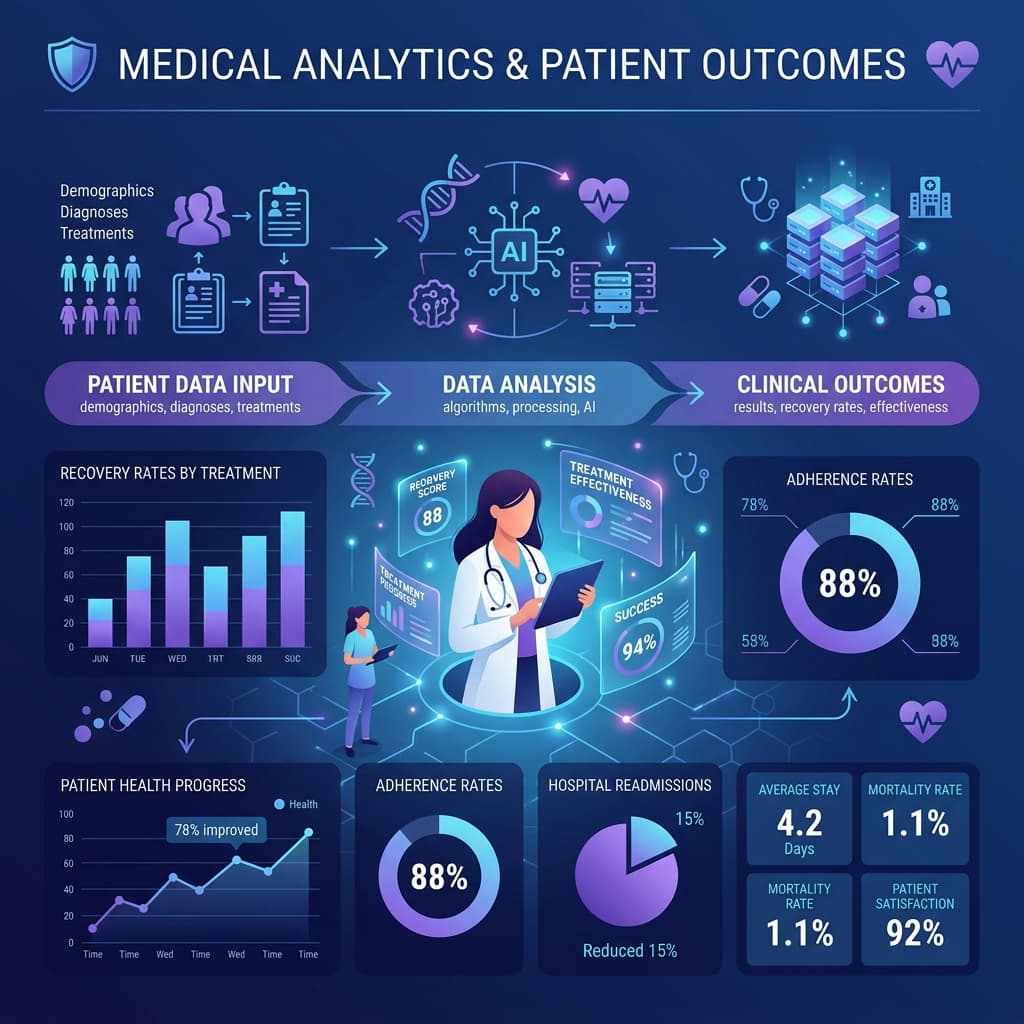
There's a sentence that decides more specialty pharmacy commercial outcomes than any other, and it appears in some form in every payer RFP, every manufacturer limited-distribution agreement, and every accreditation review: *show us your data.*
Payer network access, LDD panel seats, value-based contract eligibility, URAC and ACHC accreditation — every one of them now runs through a pharmacy's ability to demonstrate outcomes, not just dispenses. Proportion of days covered (PDC) by therapeutic class. Time-to-fill. First-fill abandonment. Adherence-driven discontinuation. Patient-reported symptom burden and side-effect profiles. Interventions made and their resolutions. Hundreds of URAC-accredited specialty pharmacies now submit annual performance measurement data, and the benchmarks published from that pool are increasingly what payers and pharma quote back at you in contracting conversations.
Here's the uncomfortable part: most of the data that proves a specialty pharmacy's value can only be collected *from the patient, by conversation*. And conversation is precisely the resource pharmacies have been rationing.
The data everyone wants and nobody can afford to collect
Dispense data is easy — it falls out of the pharmacy management system. Claims-based adherence proxies like PDC are computable, though everyone in the room knows a refill record is not the same as a swallowed pill. But the data that actually differentiates — did the patient's fatigue improve, are they injecting correctly, did they skip doses because of nausea, what's their disease-specific score this quarter — lives in structured patient conversations: patient-reported outcomes (PROs).
Manufacturers building real-world evidence (RWE) dossiers want PROs. Payers writing outcomes-based contracts want them. Accreditors expect patient management programs with documented assessments at defined intervals. And the collection mechanics are brutal by hand: a proper PRO program means reaching every enrolled patient at protocol-defined intervals — baseline, 30 days, 90 days, quarterly — administering a validated instrument consistently, recording responses as discrete data rather than free-text vibes, and doing it across thousands of patients indefinitely.
So what actually happens? Pharmacies run their clinical assessment program on whoever answers the phone during business hours. Completion rates languish. The clinical team burns hours on unanswered dials. Assessments get compressed ("any problems with your medication? great") because the queue is long. The resulting dataset is sparse, biased toward reachable patients, inconsistently administered, and stored as free text a data analyst can't use. Then the pharmacy walks into a manufacturer QBR with anecdotes where the contract required endpoints.
I've come to think of this as the industry's quietest irony: specialty pharmacy's entire premium over retail is "high-touch clinical management," and the touch that proves it is the first thing cut when staffing gets tight.
What changes when the interview scales
Voice AI attacks every failure point in that pipeline simultaneously, and this use case may be the purest fit in all of pharmacy.
Consistency: a validated PRO instrument administered by an AI agent is administered *identically* every time — same wording, same order, same probes. No drift, no shortcuts on call forty of the day. Methodologists spend careers worrying about inter-interviewer variability; an AI interviewer eliminates the category.
Coverage: the agent calls at 6:30 p.m. or Saturday morning, when patients answer. It retries intelligently, switches to the patient's preferred language, and never has a queue. Completion stops being a function of staffing and starts being a function of patient willingness — which, it turns out, is high when the call is short, relevant, and arrives at a convenient hour.
Structure: responses land as discrete, coded data mapped to the instrument, timestamped, patient-linked, and ready for the manufacturer data feed or payer reconciliation file — not as a nurse's note reading "pt doing ok, some GI upset." Your biostatistician can use it. Your NCPDP-standard-friendly data team can transmit it. Your QBR deck builds itself.
Escalation: this is the part that makes clinical teams exhale. A well-built agent doesn't just record that a patient reported worsening shortness of breath — it recognizes the response as escalation-worthy in the moment and warm-transfers to a pharmacist or flags for same-day clinical callback, with the transcript attached. The AI widens the funnel; humans still own everything the funnel catches. In practice this means clinicians spend their hours on the 8% of patients who reported something that matters, instead of dialing the 92% who are fine.
The commercial flywheel
Now connect this back to the contracts, because the strategic story is bigger than operational efficiency.
A pharmacy that can walk into an LDD negotiation with 85%+ assessment completion, longitudinal PRO trends by therapy, documented intervention-to-resolution data, and side-effect surveillance at scale is not selling dispensing capacity — it's selling an evidence engine. Manufacturers under pressure to demonstrate real-world value for six-figure therapies will pay for that, in panel seats and in data-service fees. Payers piloting outcomes-based agreements need a counterparty who can actually measure the outcomes; most can't, and the ones who can set the terms. Even accreditation flips from a cost center to a marketing asset when your performance measures sit above benchmark *and you can prove why*.
There's a defensive angle too. As URAC-style aggregate reporting matures, being unable to produce this data won't be neutral — it will be conspicuous. The pharmacies with thin patient-management evidence will find themselves explaining, in renewal meetings, why their "high-touch" program touched 30% of patients twice a year.
Building it: a realistic blueprint
For the operator who's sold on the destination, here's the honest path, because "deploy PRO collection" hides real design work.
Start by choosing instruments deliberately with your clinical team: validated, disease-appropriate, and *short* — a five-minute call completes; a twenty-minute interrogation doesn't, and completion rate is the whole ballgame. Map each instrument to a protocol: which patients, which intervals, which responses trigger which escalations, who owns the escalation SLA. Get IRB-style rigor on consent language even though this is operations rather than research — if the data might ever feed a manufacturer RWE program, the consent and data-use language you capture on day one determines what you're allowed to do with the dataset in year three, and retrofitting consent across ten thousand patients is misery.
Then wire the data path before the first call: discrete fields in the patient management system, not a transcript graveyard; therapy-level dashboards your clinical and contracting teams actually open; and an outbound feed format your manufacturer and payer partners can ingest. The most common failure mode I see isn't collection — it's pharmacies that collect beautifully into a system nobody queries.
Pilot on one therapy where the commercial stakes are legible — an LDD where the manufacturer is already asking for data is ideal — and run it long enough to produce a before/after on three numbers: assessment completion rate, time-from-flag-to-clinical-contact, and staff hours per completed assessment. Those three, moved in the right directions, fund the expansion to the rest of the book without another budget conversation.
And a warning about the metric that will tempt you: don't sell "calls made." The pharmacies that win contracts with this capability present *completion rates, longitudinal trends, and intervention outcomes* — evidence of a functioning clinical system, not evidence of a busy dialer.
The objection worth taking seriously
"Patients won't give honest clinical answers to a machine." It's the intuitive worry, and the evidence runs the other way more often than you'd expect. Decades of computer-administered survey research show respondents frequently disclose *more* to a non-judgmental automated interviewer on sensitive topics — missed doses, side effects they're embarrassed about, depression screens — than to a human they don't want to disappoint. Adherence confession is a social-desirability problem, and machines lower the social stakes. Add transparent AI disclosure, a short and respectful script, and an always-available path to a human, and the data quality argument tilts decisively toward automation.
The honest limitation is different: an AI interviewer generates signal, not care. If nothing happens downstream of a concerning PRO — no pharmacist call, no prescriber note, no intervention logged — you've built a very sophisticated way to document your own negligence. The programs that work treat collection and clinical response as one system: AI for breadth, humans for depth, and an audit trail connecting the two.
Specialty pharmacy has spent a decade telling payers and manufacturers that it's more than a logistics business. The industry was right — but "trust us" is no longer an acceptable data format. The pharmacies that thrive in the next contracting cycle will be the ones that turned every patient interaction into evidence. That's not a staffing plan away. It's a phone call away, ten thousand times a month, and the phone calls no longer require hiring anyone.