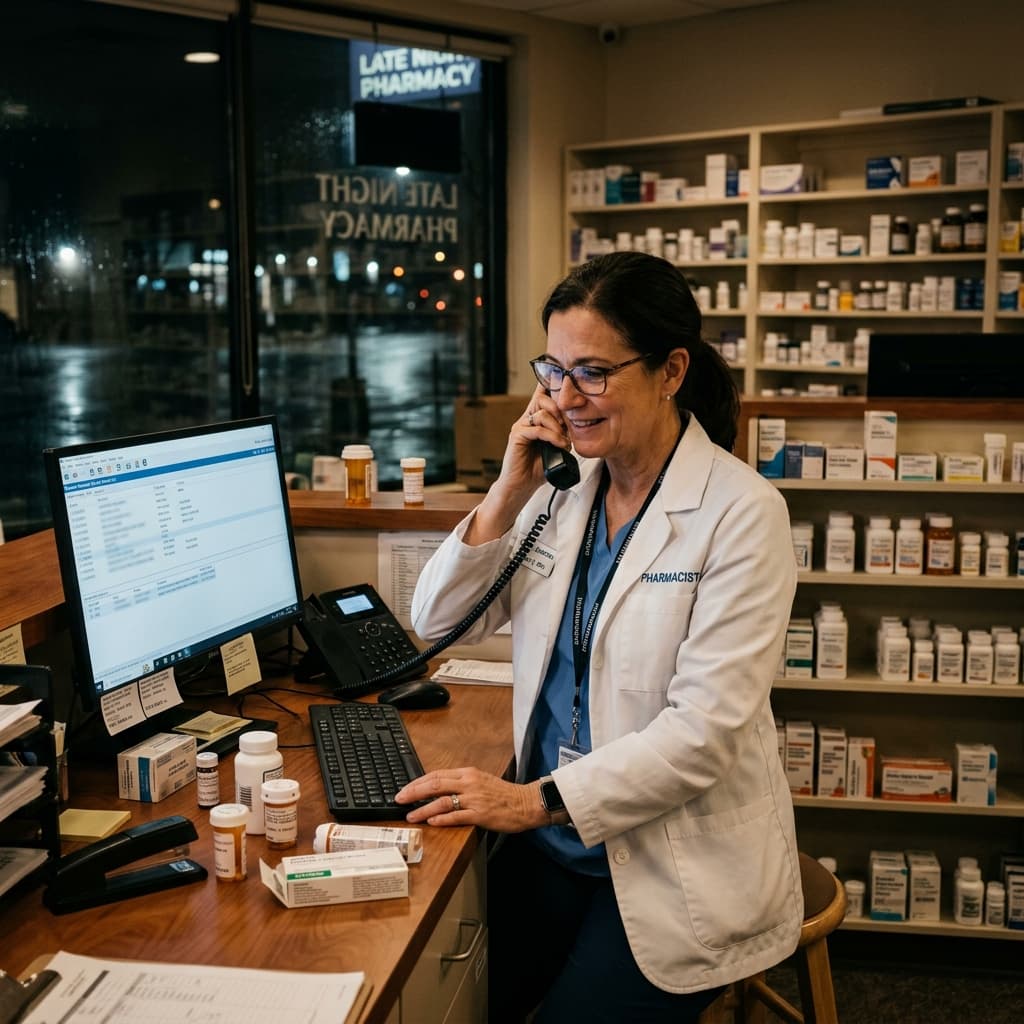
One of the first things you learn about specialty pharmacy is that the phone can never really turn off. A patient on a serious therapy can have an urgent question at 2 a.m. — a reaction, a missed dose, a delivery that didn’t show. Accreditation expectations, manufacturer contracts, and basic patient safety all push specialty pharmacies toward always-on access. And staffing a genuine 24/7 clinical line with humans is brutally expensive and hard to sustain.
This is one of the most interesting places for voice AI, and also one where you have to be the most careful.
Why always-on is the standard
Specialty pharmacies operate under accreditation regimes — URAC and others — that set standards across patient management, patient service and communication, and performance monitoring. Accredited specialty pharmacies very commonly advertise a licensed pharmacist available 24 hours a day, seven days a week, because patients on high-acuity therapies need it and because the people who send these pharmacies business — manufacturers running limited-distribution drugs, payers, hub programs — expect that level of access. Whether or not a given standard names “24/7” explicitly, the market reality is that you need to answer the phone at night.
The trouble is the economics and the human cost. Overnight call volume is unpredictable — long stretches of nothing punctuated by the call that really matters. Paying skilled clinical staff to sit through the quiet hours waiting for that call is expensive, and night shifts burn people out. So a lot of pharmacies lean on answering services that mostly just take a message, which means the patient with a real problem at 2 a.m. doesn’t actually get help until morning.
Where voice AI fits the night shift
This is a near-perfect division of labor. A voice agent is genuinely happy to answer every call at 3 a.m., instantly, with no hold time and no fatigue. It can handle the large share of after-hours calls that are routine — “where’s my order,” “when’s my refill,” “how do I store this” — completely, right then. And for the calls that aren’t routine, its single most important job is triage: recognize urgency, gather the key information, and escalate to the on-call pharmacist immediately and intelligently, so the human is woken up for the call that matters and not the twentieth status check.
That flips the overnight model. Instead of a pharmacist staffing the quiet hours or an answering service taking dead-end messages, you have an agent that resolves the routine, triages the serious, and reaches a human the moment clinical judgment is needed. The patient gets an immediate, competent response at any hour. The pharmacy gets always-on coverage without burning out its clinical team.
The line you must not cross
Here’s where I get serious. The agent must never pretend to be a clinician or try to handle something clinical it shouldn’t. The whole design has to be built around safe escalation: when in doubt, get a human. An after-hours agent that improvises medical advice is a catastrophe waiting to happen, and it would deserve every bit of the fallout. The right system is conservative by design — it does the routine confidently and escalates anything clinical fast and cleanly. That conservatism isn’t a limitation; in this context it’s the entire point.
Compliance and the record
Always-on also means always-logged. Every after-hours interaction gets captured — what the patient said, what the agent did, when and how it escalated. That audit trail matters for accreditation, for quality monitoring, and for the next article in this series, which is all about FDA reporting obligations. A 24/7 agent that documents itself thoroughly is, in a real sense, easier to stand behind than a patchwork of answering services and message slips.
The takeaway
The 24/7 requirement is one of the heaviest fixed costs and staffing headaches in specialty pharmacy. Voice AI doesn’t eliminate the need for human pharmacists — it makes the always-on promise sustainable by handling the routine, triaging the urgent, and protecting your clinicians’ nights. Buyers feel that as cost relief and better patient access. Investors should see it as one of the stickiest value propositions in the category: once a pharmacy trusts an agent to cover its nights safely, it’s not going back.