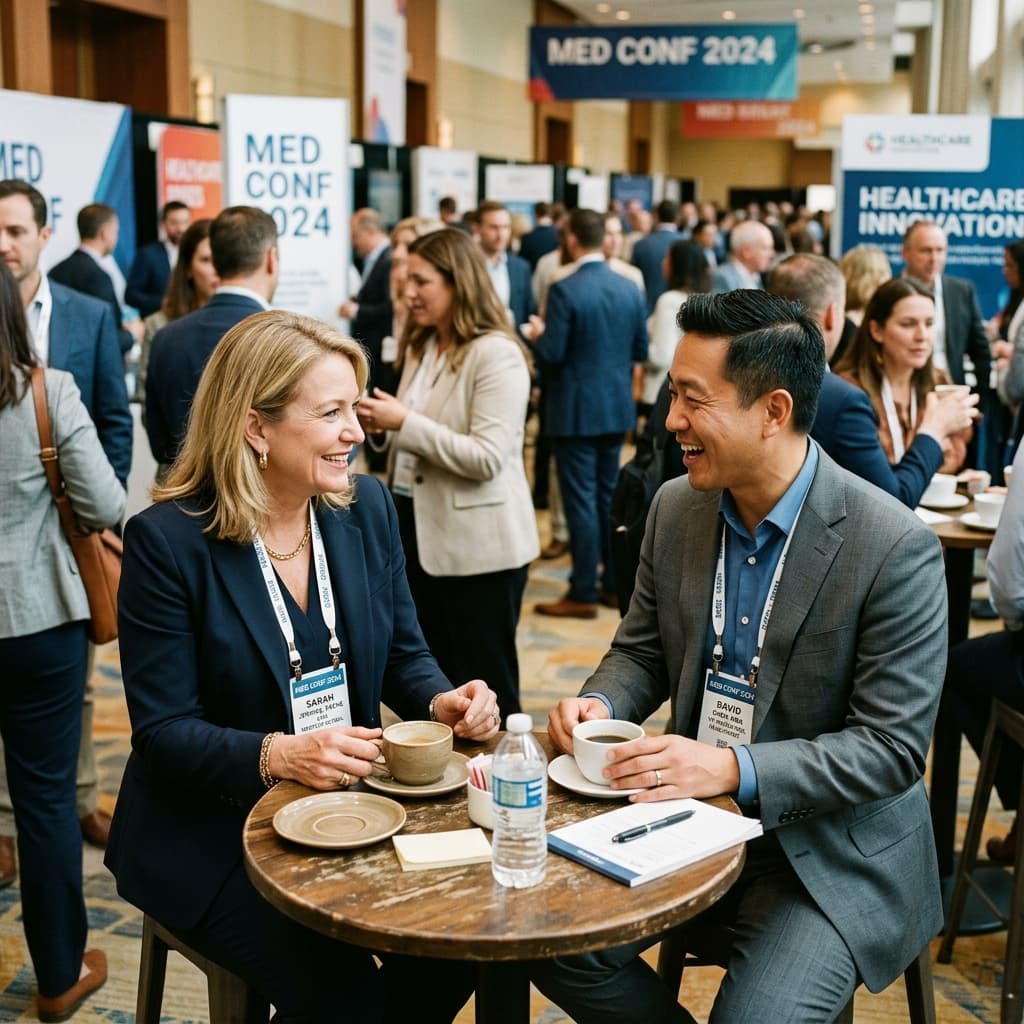
I’ll say it plainly: Asembia’s AXS Summit is one of the best conferences I’ve been to, and I’ve been to a lot of them. If you want to understand specialty pharmacy, you go to Asembia. It’s where the industry physically gathers — over 8,000 professionals at the Wynn and Encore in Las Vegas, the whole ecosystem in one place: pharmacies, manufacturers, hub services, payers, technology vendors, the people who actually run this business. And underneath the scale, it has a quality I didn’t expect: it’s intimate. The conversations are real.
Why this conference is different
A lot of big conferences are theater. You fly in, you present a deck to a room, everyone high-fives each other, you post a photo on LinkedIn, and you go home without a single real lead. I’ve done that version. It doesn’t translate to anything.
Asembia is the opposite. My whole strategy at conferences is boots on the ground — skip most of the show floor sessions and just book as many coffees and one-on-ones as I can, because that’s where the truth comes out. When it’s two people across a table instead of fifteen in a conference room, people actually tell you what’s broken. At AXS, that’s the entire culture. It’s dense with the right people and built for the kind of candid, in-person conversation that’s still the best lead generation there is. Some of my real customers came from exactly this kind of room.
What the agenda told me about where the industry’s head is at
The summit’s program is a pretty good read on the industry’s priorities, and automation runs through all of it. The big AXS themes have centered on patient engagement platforms, digital pharmacy solutions, specialty pharmacy economics, supply-chain challenges, and the impact of policy like the Inflation Reduction Act on drug pricing and reimbursement. Read between the lines and it’s the same story this whole collection has been telling: the drugs are getting more numerous and more expensive, the margins are getting squeezed, and the operational burden of getting these therapies to patients is the pressure point everyone is feeling.
The thing I couldn’t stop noticing: the demand for automation
Here’s what really stuck with me. Almost every conversation I had bent, eventually, toward the same need: “we are drowning in operational work and we don’t have enough people.” Pharmacy operators talked about call volumes that sounded impossible. Hub and patient-services folks talked about benefit verification and prior auth eating their teams alive. Everyone, in their own words, was describing a labor problem that automation is the obvious answer to — and specifically a communication-and-phone problem, which is voice AI’s exact shape.
The demand for voice AI and automation in that room was real and it was loud, even from people who didn’t have the vocabulary for it yet. That’s a great sign for a founder. It’s much easier to sell into a market that already knows it’s in pain than to convince people they have a problem. At AXS, nobody needed convincing they had a problem. They needed someone to show up with a credible answer.
The competitive read
I’ll be honest about the flip side, because I try to be. There were a lot of great companies there — sharp people building real things across the specialty value chain. It’s not an empty field. But what I noticed is that very little of it was purpose-built voice AI for the specific operational workflows we’ve been talking about. There’s a lot of platforms, a lot of services, a lot of analytics. The specific gap — an agent that actually gets on the phone, integrates with the pharmacy’s system, and handles the 80,000 calls — was wide open. That’s the lane.
What I took home
Three things. One, the pain is real, quantified, and felt at the top — these are decision-makers who live the operational burden every day. Two, the appetite for automation is already there; the market is leaning in, not resisting. Three, the room is intimate enough that relationships and proof travel fast — win a few of these pharmacies well and the word moves through exactly this kind of gathering. I left more convinced than when I arrived, which doesn’t always happen at conferences. Usually I leave tired. This time I left with a thesis and a notebook full of coffees that turned into something.